





















Frequently Asked Questions
Home » Frequently Asked Questions
Why use an insurance broker?
What's the difference between an agent and a broker?
Why choose EBM?
How can I be sure my broker is qualified?
How are insurance brokers licensed and what controls are there?
How do I know EBM will act fairly on my behalf?
How can I be sure an insurance company is financially sound?
How can I be sure an insurance broker will pass on my premiums?
What insurance policies do I need?
How much insurance is enough?
If my circumstances change do I need to review my insurance?
Should I simply look for the cheapest policy?
How do I make a claim?
What is a Financial Services Guide (FSG)?
What is a Product Disclosure Statement (PDS)?
Why use an insurance broker?
As
insurance brokers, our priority is to represent your interests at all
times, and to provide you with professional guidance in everything
pertaining to your insurance in a market that's forever changing in
premiums, product availability and policy conditions. EBM's team of
Qualified Practising Insurance Brokers are trained to understand the
differences between various policies and can often able to negotiate
premiums that aren't available to you. In fact some insurance policies
are only available through intermediaries such as brokers.
Our
role as brokers is to source the most appropriate policies for your
circumstances and to advise on the various areas of risk for you or
your company.
Top
What's the difference between an agent and a broker?
An
insurance broker has a duty of care to you and must act in your best
interests, they will attempt to source the most appropriate policy on
your behalf at a competitive premium. An agent represents the insurance
company and therefore has no direct responsibility to ensure that you
are getting the most appropriate policy available, only to ensure that
you are getting the most appropriate policy from the company's range.
In
some circumstances a broker may act as an agent for the insurer and not
as your agent. This is often the case with schemes that have been
negotiated with a particular insurer (in these cases there is likely to
be benefits of the scheme that would not be available by negotiating
with different insurers). In these circumstances the broker will
clearly advise that they are acting as an agent for the insurer and not
as your agent.
Top
Why choose EBM?
We have been established since 1975.
We are among the top ten Insurance Brokers operating in Australia.
Our service is personal, and you deal with the same brokers at all times.
We are foundation members of NIBA (National Insurance Brokers Association).
We provide you with comparative terms from insurers to save you time
and money, and we are always available to provide you with expert
advice.
We are innovative and well respected.
We are large enough to perform in all situations, yet small enough to care.
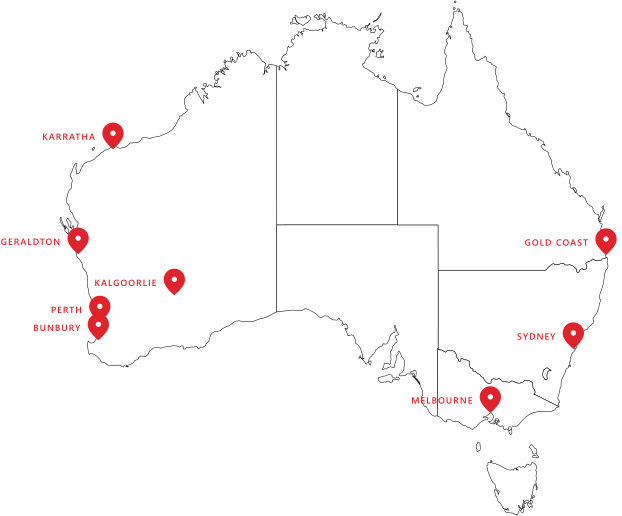
We operate throughout Australia with a network of offices in New South
Wales, Victoria, Queensland and Western Australia.
Top
How can I be sure my broker is qualified?
All
of EBM's senior brokers are Qualified Practising Insurance Brokers
(QPIB's), proof of our willingness to voluntarily abide by a tough
system of professional accreditation. Our brokers maintain their
professional status by undertaking the required ongoing training and
development as an absolute minimum - all of our senior brokers exceed
this requirement substantially. It is a requirement of the Australian
Securities and Investments Commission (ASIC), which regulates the
insurance industry, that all insurance brokers have attained or are
working towards their Diploma of Financial Services (Insurance
Broking), and EBM is compliant with all ASIC requirements.
Top
How are insurance brokers licensed and what controls are there?
Insurance brokers are licensed by the Australian Securities and
Investments Corporation (ASIC). EBM holds a Financial Services Licence
as is required by law. EBM's Financial Services Licence No. is 246986.
Top
How do I know EBM will act fairly on my behalf?
We
at EBM embrace the General Insurance Brokers Code of Practice which is
intended to promote good relationships between insurance brokers, the
people they insure, insurers and others involved in the insurance
industry.
The Code is part of a self-regulatory scheme
that sets out the responsibilities of participating insurance brokers
and requires them to establish an internal process for resolving
disputes with policy holders. Complaints and disputes against brokers
in relation to the Code are handled by Insurance Brokers Disputes Ltd,
whose members represent consumers, the Government and insurance brokers.
There
are also a considerable number of laws that apply to our business, in
particular the Corporations Act. As a financial services licensee we
are responsible for the conduct of our employees as well as our
Authorised Representatives.
Top
How can I be sure an insurance company is financially sound?
Most insurance companies operating in Australia are financially sound
and the regulatory body, the Australian Prudential Regulatory Authority
(APRA), maintains strict controls to ensure this continues. APRA
oversees the activities of insurance companies, banks, credit
societies, superannuation companies and others in the financial arena.
There are minimum Capital Adequacy levels for APRA authorised insurers.
EBM also maintains a security committee, whose job it is to monitor and
review all of our EBM approved insurers to ascertain their capacity to
meet their obligations to our customers. Your broker is trained to
further assist in ensuring the insurer with whom your business is
placed performs to the standards you would expect.
Top
How can I be sure an insurance broker will pass on my premiums?
Holders of Australian Financial Services Licences (such as insurance
brokers) are subject to stringent legislative requirements concerning
the receipt and payment of premiums. Insurance brokers are responsible
for arranging most of the general insurance cover for businesses in
Australia, and it is estimated that ninety per cent of all
broker-placed business is handled by members of the National Insurance
Brokers Association of Australia (NIBA). NIBA works closely with
government on the controls of insurance brokers to ensure financial
stability and ethical conduct.
Top
What insurance policies do I need?
This depends on the type of business you are in. New insurance policies
are being developed constantly as the world and the risks you face
change. As an example, even 20 years ago how many businesses would have
considered having insurance for loss of profits due to computer crime?
EBM's brokers undergo regular training and remain abreast of all
developments within the industry, so they are well placed to regularly
review your risk areas and advise accordingly.
Top
How much insurance is enough?
The first step in determining the answer to this question is to work
with your broker to identify and define the areas of risk for you or
your business. The decision then is which risks to retain (ie, not
insure) and which risks to transfer through insurance. The sums insured
should be relevant to the risk, taking special care not to underinsure
and be subjected to co-insurance clauses. To choose to take the risk
yourself to save money can leave you vulnerable and may severely affect
your cash flow or assets. This is where our experience can assist you
in making decisions on how much insurance you require to adequately
cover your various risks.
Top
If my circumstances change do I need to review my insurance?
Absolutely. A change of circumstances may mean the insurance you have
in place is no longer current. It may be that your circumstances change
in a way that means your risk is reduced and you're paying too much, or
that your risk is increased and you're exposed to uninsured losses.
Either way, advising your broker of your changes will allow them to
review your insurances and ensure your policies remain relevant. It's
advisable to review your insurance regularly - at the very least
annually - because changes may have taken place that alter your risk
profile, and the policies available to cover your risks may also have
changed.
Top
Should I simply look for the cheapest policy?
Insurance policies can be very complex, and the cheapest policy will
not always meet all of your needs. Sometimes what is left out of a
policy is as important as what is included, and the cheapest option may
omit a risk that you cannot afford to carry yourself. Interpreting the
terms of the policy is part of your EBM broker's role and you should
listen to their advice as you would a doctor or a lawyer. Although the
policy cost will always be a factor, ensuring you have the right cover
in place when it comes the time to make a claim is vital, and our top
priority.
Top
How do I make a claim?
The process for lodging a claim varies depending on the type of policy,
the insurer and the circumstances. You should first refer to Claims Procedure
for general information. Your EBM broker is trained and more than happy
to assist in the claims process to ensure you receive everything you
are entitled to. You should make contact with them as soon as possible
after a loss event occurs, so that no time is lost.
Top
What is a Financial Services Guide (FSG)?
A
Financial Services Guide (FSG) must be given to a potential client by a
licensee (or an Authorised Representative) as soon as practicable. It
sets out information in regard to how we do business such as:
- Documenting the standard basis on which we act for the client.
- Providing all statutory notices and other information required by law (e.g. how we get paid).
- Explaining how we will handle a client’s business
EBM's Financial Services Guide is readily available by contacting one of our offices or by clicking here.
Top
What is a Product Disclosure Statement (PDS)?
A
Product Disclosure Statement (PDS) should be provided to retail clients
prior to them making a decision to purchase an insurance policy. The
PDS is issued by the insurer and highlights significant information
about the policy of which you should be aware. This includes
information about the insurer, significant benefits and features,
things that are not covered, significant risks and other important
information. You should carefully read the PDS prior to making a
decision about purchasing an insurance policy.
Top